AI - Demystifying LLMs
The 5-Step Generation Loop Every Data Leader Should Understand
As Chief Data Officers increasingly integrate generative AI into enterprise strategy, understanding how these systems actually work isn't just technical curiosity—it's a governance imperative. Here's your executive-level technical briefing on the mechanics behind every ChatGPT response, every Claude conversation, and every enterprise LLM deployment.
Large Language Models have become central to digital transformation discussions in boardrooms worldwide. Yet many data leaders find themselves making strategic decisions about AI adoption without a clear understanding of what happens between a user's prompt and the model's response. This knowledge gap creates real risks—from setting unrealistic expectations to implementing inadequate governance frameworks.
Let's demystify the process. Every time an LLM generates text, it executes a precise 5-step loop that repeats for each word (or rather, each "token") in its response. Understanding this loop transforms how you evaluate, deploy, and govern these systems.
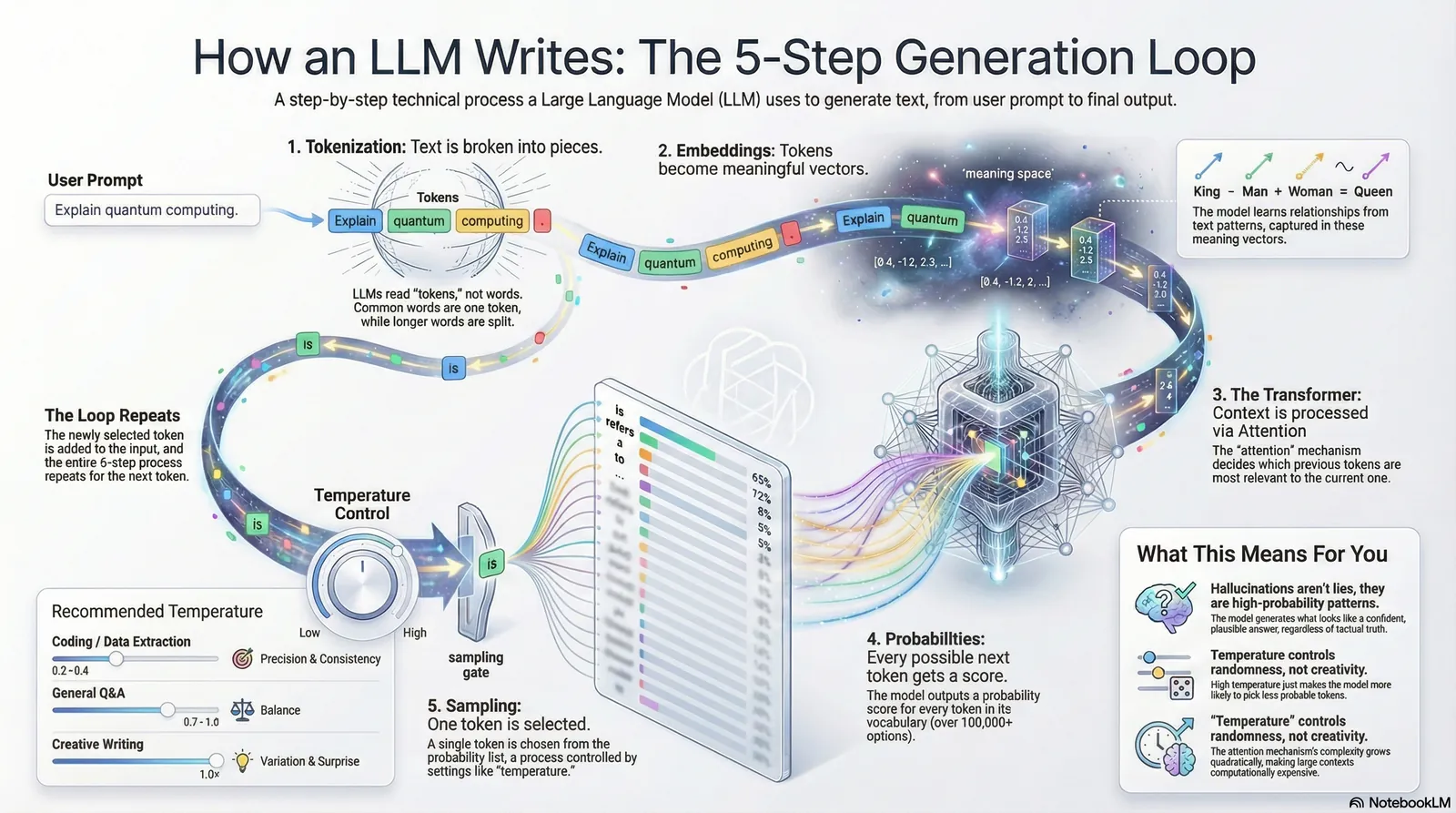
The 5-Step Generation Loop
When you submit a prompt to an LLM, you're initiating a computational process that will repeat potentially thousands of times before your response is complete. Each iteration produces exactly one token of output. Here's what happens in each cycle:
- Tokenization
The model doesn't read words—it reads "tokens." Common words like "the" or "is" typically equal one token, while longer or less common words get split into multiple pieces. The prompt "Explain quantum computing" becomes something like
["Explain", " quantum", " computing"]. This tokenization affects everything from pricing (API costs are per-token) to the model's handling of unusual words or technical terminology. - Embeddings
Each token is converted into a high-dimensional numerical vector—typically 4,096 to 12,288 dimensions. These vectors exist in what researchers call "meaning space," where semantic relationships are encoded geometrically. The famous example: the vector for "King" minus "Man" plus "Woman" approximately equals "Queen." This mathematical representation of meaning is what allows LLMs to understand context and relationships.
- Attention
The transformer architecture's "attention mechanism" determines which previous tokens are most relevant to predicting the next one. When generating text about "the bank," attention helps the model understand whether you mean a financial institution or a riverbank based on surrounding context. This mechanism is computationally expensive—complexity grows quadratically with context length.
- Probabilities
The model outputs a probability score for every token in its vocabulary—over 100,000 possibilities. After processing "The capital of France is," the model might assign 65% probability to "Paris," 8% to "a," 5% to "the," and so on. These probabilities reflect patterns learned during training, not factual knowledge or reasoning in the human sense.
- Sampling
A single token is selected from the probability distribution. This selection process is controlled by parameters like "temperature." The selected token is then added to the input, and the entire 5-step loop repeats for the next token. This continues until the model produces a stop token or reaches its maximum length.
Understanding Temperature
Temperature is perhaps the most misunderstood LLM parameter. It doesn't control creativity—it controls randomness in token selection. Low temperature means the model almost always picks the highest-probability token. High temperature flattens the probability distribution, making lower-probability tokens more likely to be selected.
0.2 – 0.4
Maximum precision and consistency
0.7 – 1.0
Balanced responses with natural variation
1.0+
More variation and unexpected outputs
Strategic Implications for Data Leaders
Understanding the generation loop reframes several critical governance and strategy questions:
Hallucinations Aren't Lies
They're high-probability patterns. The model generates what statistically "sounds right" based on training data—regardless of factual accuracy. This is an architectural feature, not a bug to be fixed.
Context Length Has Real Costs
The attention mechanism's quadratic complexity means that doubling your context length roughly quadruples computational cost. This affects pricing, latency, and architecture decisions.
Determinism Is Controllable
With temperature at 0 and fixed random seeds, you can get reproducible outputs—critical for audit trails and compliance documentation in regulated industries.
Practical Recommendations
Based on this technical understanding, here are actionable recommendations for your AI governance framework:
First, implement output validation layers for any LLM deployment involving factual claims. The model has no internal mechanism to distinguish confident-sounding falsehoods from accurate information—that responsibility falls to your systems and processes.
Second, standardize temperature settings by use case across your organization. Ad-hoc parameter selection leads to inconsistent outputs and makes quality assurance nearly impossible. Document your choices and the reasoning behind them.
Third, factor token economics into your AI strategy. Understanding that every response involves thousands of probability calculations—and that costs scale with context length—enables more accurate budgeting and architecture decisions.
The organizations that will succeed with AI are those that understand both its remarkable capabilities and its fundamental limitations—and design their governance accordingly.
Looking Forward
The 5-step generation loop has remained fundamentally stable even as models have grown larger and more capable. Understanding this foundation equips you to evaluate new developments critically—whether that's longer context windows, multimodal capabilities, or claims of "reasoning" abilities.
As data leaders, our role isn't to become AI researchers, but to understand these systems deeply enough to govern them wisely. The generation loop is your mental model for that governance—a reminder that behind every impressive AI output is a statistical process that requires human oversight, clear use-case boundaries, and robust validation frameworks.
The question isn't whether to adopt LLMs—that decision has largely been made by market forces. The question is whether you'll deploy them with the technical understanding needed to capture their value while managing their risks. This 5-step loop is where that understanding begins.